

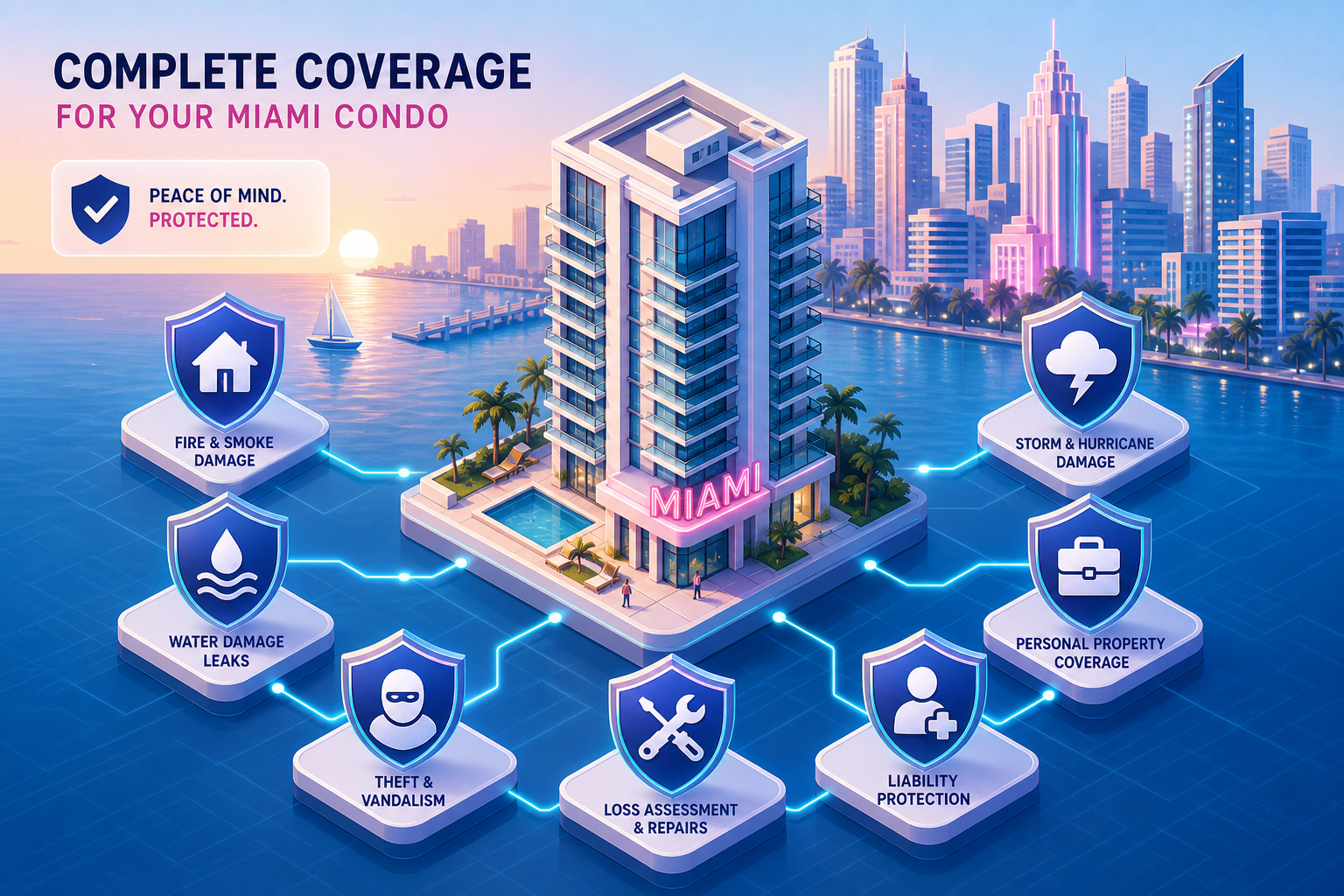
If you’re wondering what condo insurance typically covers in Miami, the answer starts with understanding the gap between your HO-6 and your building’s master policy. Picture a Brickell condo owner who files a claim after hurricane-season water intrusion soaks their hardwood floors, damages their custom cabinetry, and renders the unit unlivable for six weeks. They assumed the building’s insurance had them covered. What they discovered instead was a coverage gap that left them holding a five-figure repair bill. This scenario commonly occurs after major storms in Miami-Dade, and it’s almost always preventable.
At We Insure Downtown Miami, we review HO-6 policies for clients regularly, and the same gaps appear across buildings: wrong loss assessment limits, no flood coverage, hurricane deductibles that blindside people at claim time, and a misunderstanding of what the master policy actually handles. If you own a condo in Miami-Dade, understanding your Miami condo insurance coverage isn’t a nice-to-have. It’s financial protection you can’t afford to skip.
Here are the seven key things your Miami condo insurance should cover, along with the context you need to make sure your policy actually delivers when it matters.
What Condo Insurance Covers in Miami: Interior Structure First
Your HO-6 policy covers the interior of your unit, which professionals often call “walls-in” coverage. That means drywall, paint, flooring, cabinetry, countertops, interior doors, built-in fixtures, and trim all fall under your policy’s protection. The building exterior, roof, foundation, and shared walls are the association’s responsibility under their master policy.
The practical catch is that “walls-in” is shorthand, not a legal definition. The exact dividing line between what you own and what the association insures is written in your governing documents. Before you assume your flooring or kitchen cabinets are covered by the building policy, pull the association’s declarations page and compare it against your HO-6. That comparison is one of the most important steps a Miami condo owner can take. For a Brickell-specific breakdown of common HO-6 issues and how to address them, see our Brickell Condo Insurance (HO-6) Buyer’s Guide, 2025 Edition.
2. Personal Property: Everything You Own Inside Those Walls
Furniture, electronics, clothing, artwork, appliances, and décor are all covered under the personal property section of your HO-6. The coverage limit you choose should reflect the actual value of what you own, not a round number you picked at sign-up. Many owners underestimate the value of their contents and find themselves underinsured when a claim arrives.
Pay close attention to whether your policy pays claims at replacement cost value or actual cash value. Replacement cost pays what it costs to buy the item new today. Actual cash value deducts for depreciation, so a five-year-old laptop that costs $1,200 to replace might only pay out $400. For Miami condo owners with upgraded interiors and quality furnishings, replacement cost coverage is worth the added premium. A quick home inventory, even just photos walked room by room, gives you a realistic baseline for setting that limit.
3. Loss of Use Coverage: What Happens When Your Unit Is Unlivable
If a covered loss makes your unit uninhabitable, loss of use coverage (sometimes called additional living expenses) pays for temporary housing, meals, and other costs beyond what you’d normally spend. In Miami, where short-term rental rates run high and hotel options near Brickell and Downtown are expensive, a modest loss of use limit disappears fast. After major hurricanes, some unit owners have been displaced for months, not weeks.
The critical detail here is that loss of use limits vary significantly between carriers, and many owners don’t notice the difference until they’re already displaced. If your building takes a serious hit and multiple units are uninhabitable at once, local temporary housing demand spikes and prices follow. Make sure your limit reflects what it actually costs to live in Miami temporarily, not what it costs somewhere else.
4. Personal Liability Inside Your Unit
If a guest is injured inside your unit, or if water damage originates in your unit and travels to a neighbor’s floor below, your HO-6 liability coverage responds. Standard liability limits often start around $100,000, but that number falls short quickly when you factor in medical costs, legal fees, and property damage claims in a dense urban building where units are stacked directly above and below each other.
Miami condo owners should consider higher liability limits, such as $250,000 to $500,000, depending on their exposure, and many benefit from adding an umbrella policy on top of that for broader protection. A single burst pipe that cascades through multiple floors below yours can generate a claim that far exceeds a baseline limit. The premium difference between a lower and higher liability limit is often modest, though it varies by carrier and underwriting; the coverage difference, however, can be substantial.
How the Building’s Master Policy Shapes What You Actually Need
Bare Walls, Single Entity, and All-In: The Three Master Policy Types
This is where most Miami condo owners get into trouble. The association holds a master policy that covers the building structure and common areas, but the type of master policy determines how much interior coverage falls to you personally. There are three types, and confusing them is one of the most common mistakes we see.
- Bare walls: the association covers the structural shell only. You must insure all interior finishes from the drywall surface inward, including flooring, cabinetry, countertops, fixtures, and appliances.
- Single entity (original specifications): the association covers original fixtures and finishes as they were when the building was built. If you installed upgraded flooring or custom cabinets, those improvements fall to you.
- All-in: the association covers original and upgraded finishes. Your HO-6 mainly handles personal property, liability, and any improvements that exceed what the master policy defines.
If you don’t know which type your building carries, you are flying blind when setting your HO-6 dwelling limit. Obtain a copy of the association’s declarations page, review the master policy type, and calibrate your HO-6 accordingly. This step alone closes the gap that catches Miami owners off guard at claim time.
5. Hurricane and Storm Damage: Miami HO-6 Coverage and Deductibles Explained
Why Percentage-Based Hurricane Deductibles Matter More Than You Think
HO-6 policies in Miami typically do cover windstorm and hurricane damage to the parts of the unit the policy insures. However, hurricane deductibles in Florida are percentage-based, not flat dollar amounts. They commonly run between 2% and 5% of the insured value, with 10% available on some policies.
Run the math on a real scenario: if your interior is insured for $200,000 and your hurricane deductible is 5%, you pay $10,000 out of pocket before the policy responds. At 2%, that number drops to $4,000, still a meaningful sum when you’re also dealing with displacement costs and contractor delays. Many condo owners don’t realize how large their hurricane deductible is until they file a claim. Ask your agent to walk through the exact deductible language before you finalize any policy.
Flood Is Always a Separate Purchase
Flood damage from storm surge, rising water, or overwhelmed drainage systems is excluded from standard HO-6 policies across virtually every carrier. This isn’t a fine-print technicality; it’s a core policy exclusion that applies to everyone. Miami condo owners need separate flood insurance, either through the National Flood Insurance Program (NFIP) or a private flood carrier. For local guidance on options and typical costs, review our page on Flood Insurance in Miami or see an overview of flood insurance for condo units to understand the differences between NFIP and private-market choices.
One detail that catches people off guard: flood policies carry a standard 30-day waiting period before they take effect. Buying flood insurance after a named storm enters the Gulf is too late. If you don’t already have a separate flood policy, add it now and don’t wait for a storm warning to prompt the conversation.
6. Loss Assessment Coverage: Protection Against Surprise Association Bills
After a major building claim, such as a hurricane loss, large fire, or significant water event, the association may not have enough in reserves or master policy coverage to cover the full cost. The shortfall is billed directly to unit owners as a special assessment. Loss assessment coverage on your HO-6 pays your share of that bill, up to the policy limit.
Florida law requires a minimum of $2,000 of loss assessment coverage on HO-6 policies. That amount is not sufficient protection for buildings in Miami-Dade, where storm-related assessments can run tens of thousands of dollars per unit after a significant event. For a detailed legal and practical explanation, see loss-assessment coverage under the HO-6 condominium policy. At We Insure Downtown Miami, we recommend at least $50,000 for most condo owners, and $100,000 for coastal, high-rise, or high-value buildings. Increasing the loss assessment limit typically adds only modest dollars to your annual premium, making it one of the best value moves available on an HO-6 policy.
7. Key Endorsements Worth Adding to Your Miami Condo Policy
A base HO-6 policy leaves several gaps that endorsements can close. These three are the ones we see Miami clients add most frequently, and each one addresses a specific, real exposure.
- Ordinance and law / building code upgrade coverage: pays the extra cost to rebuild or repair to current building codes after a covered loss. Miami has older building stock subject to significant code-compliance costs during post-storm repairs. For an explanation of how ordinance and law coverage works and why it’s important, review this ordinance and law coverage primer. Florida law requires insurers to offer this coverage up to 50% of your dwelling limit; choosing a higher percentage provides meaningfully better protection.
- Water backup coverage: covers damage from backed-up drains, sewers, or sump pumps. Standard policies exclude this, but in a high-rise building where a neighbor’s plumbing problem can flood your floors, this coverage is practical insurance against a common cause of loss.
- Sinkhole coverage: Florida’s geology makes ground-movement damage a real exposure, and the endorsement covers structural damage caused by subsurface activity. It adds to your premium, but it provides catastrophic-loss protection that the base policy doesn’t touch.
For a broader look at common optional HO-6 endorsements and how they close coverage gaps, see an overview of HO-6 endorsements and optional coverages.
Making Sure Your HO-6 and Master Policy Actually Work Together
Not all HO-6 policies are built the same way. One carrier may offer $50,000 in loss assessment coverage at a comparable premium to another carrier with a $2,000 limit. Endorsement availability, deductible structures, and replacement cost provisions vary by carrier and aren’t visible on a simple price-comparison site. The differences live in the policy language, not the premium line.
As an independent agency, We Insure Downtown Miami has access to multiple carriers and runs side-by-side comparisons of coverage terms, deductibles, limits, and endorsement options for condo clients across Brickell, Downtown, and beyond. In our experience, this kind of comparison regularly uncovers meaningful gaps or savings that a single-carrier quote never reveals. If you want a starting point for coverage options and local market context, our main HO-6 overview explains common coverages and how we approach policy selection: Brickell Condo (HO-6) Insurance.
Before you buy or renew your HO-6, bring these questions into the conversation:
- What type of master policy does our association carry: bare walls, single entity, or all-in?
- What is the association’s hurricane deductible, and is any portion assessed to individual unit owners?
- Does my personal property coverage pay at replacement cost or actual cash value?
- What is my current loss assessment limit, and is it sufficient given the building’s hurricane exposure?
- Do I have ordinance and law coverage, and at what percentage of my dwelling limit?
What Condo Insurance Typically Covers in Miami: Getting Your Policy Right
Understanding what condo insurance typically covers in Miami comes down to one question: where does your HO-6 end and the master policy begin? The risks here are specific and measurable. Hurricane deductibles can run into the thousands before coverage kicks in. Flood requires a completely separate policy with a 30-day waiting period. Association assessments can arrive without warning after any major storm.
The good news is that all of these gaps are fixable once you know they exist. Contact We Insure Downtown Miami for a policy review. Bring your current declarations page and the association’s master policy summary, and we’ll identify any gaps, recommend appropriate limits and endorsements, and compare carriers to close them. Every Miami condo owner deserves that clarity before the next storm season arrives.
Leave a Reply