

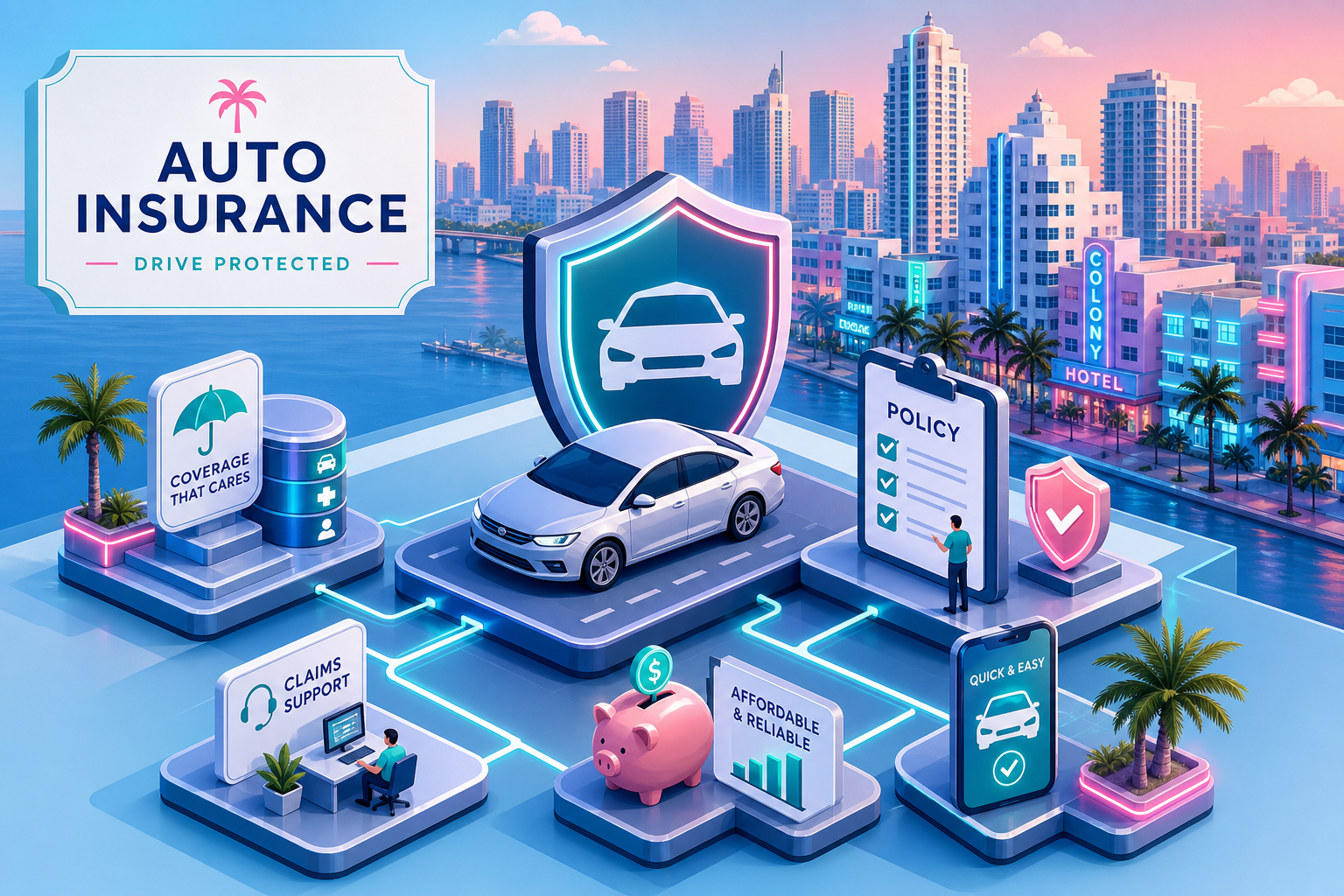
Florida auto insurance costs rank among the highest in the country, according to 2026 data from Bankrate and Insurify, and most drivers have no idea why they’re paying what they pay. The state runs on a unique no-fault system, carries one of the worst uninsured driver rates in the nation (roughly 20% of drivers, per NAIC data), and sits in a geography that adds hurricane, flood, and theft exposure to every policy calculation. Drivers who auto-renew without shopping can overpay significantly; aggregator studies consistently show that comparing carriers at renewal produces measurable savings for most policyholders.
This guide covers exactly what Florida law requires you to carry, what drivers in Miami, Tampa, Orlando, and Jacksonville actually pay in 2026, and the specific moves that bring premiums down. At We Insure Downtown Miami, our Brickell-based team works with multiple top carriers daily, so everything here reflects real-world market conditions rather than generic guidance. By the end, you’ll have the knowledge to make smarter decisions on your next policy.
What Florida actually requires you to carry
The PIP and PDL rules in plain English
Florida requires every registered vehicle owner to carry a minimum of $10,000 in Personal Injury Protection (PIP) and $10,000 in Property Damage Liability (PDL). PIP covers your own medical bills after an accident, regardless of who caused the crash. PDL covers damage your vehicle does to someone else’s property. These two minimums have not changed for 2026 and remain the baseline for registration and renewal.
What makes Florida different from most states is the PIP requirement itself. Rather than waiting to fight over fault, your own insurer pays your medical costs first. PIP typically covers 80% of reasonable medical expenses and 60% of lost wages, up to the policy limit. To access those benefits, you must seek medical treatment within 14 days of the accident. Miss that window and your claim can be denied entirely.
What “no-fault” means for your claims
In a no-fault state, your insurer handles your medical bills first and the other driver’s insurer handles theirs. The system was designed to reduce lawsuits over minor accidents. In practice, it also limits what you can recover: PIP does not pay for pain and suffering, and the $10,000 limit disappears fast when ambulance rides, imaging, and specialist visits stack up.
There is one additional detail worth knowing. If a provider determines you have an Emergency Medical Condition (EMC), you get access to the full $10,000 benefit. Without that finding, coverage may be capped at $2,500. If your injuries meet Florida’s serious injury threshold, you can pursue a separate liability claim against the at-fault driver for damages beyond what PIP covers.
Penalties for driving without coverage
The Florida DHSMV does not treat lapses lightly. Driving without the required PIP and PDL coverage can result in suspension of both your license plate and your driver’s license. Reinstating them costs money and time, and the reinstatement fees compound if the lapse continues. Keeping continuous coverage is always cheaper than dealing with the suspension cycle.
What Florida auto insurance actually costs in 2026
Full coverage vs. minimum coverage averages
The honest answer is: it depends on your source and your profile. Full coverage in Florida runs roughly $2,300 to $3,884 per year based on data from Bankrate, Insurify, Harbour Insurance, and Greene Insurance. Minimum coverage lands between $1,042 and $1,631 annually across the same sources. That spread exists because each source uses different driver profiles, coverage assumptions, and data sets.
The most useful way to read those numbers is as a realistic range, not a single target. A 35-year-old with a clean record in a mid-range sedan will generally land closer to the lower end of the range, based on typical driver profiles used by major rating sources. A younger driver with a sports car or any at-fault accidents will move toward the top. Your actual rate requires an actual quote with your real information.
Florida auto insurance rates by city: Miami, Tampa, Orlando, Jacksonville
Location moves the needle significantly across Florida’s four major metros. Full coverage monthly estimates from Insurify show Tampa at $283, Miami at $282, Orlando at $248, and Jacksonville at $227. MoneyGeek’s numbers put Miami and Tampa both at $315 per month, Orlando at $227, and Jacksonville at $212. The consistent finding across sources is that Miami and Tampa are the most expensive, and Jacksonville is the cheapest.
Miami’s position at the top is not random. Dense traffic, higher theft rates, and the concentration of uninsured drivers all push premiums up. If you park in Brickell, Edgewater, or Little Havana, your garaging ZIP code is part of the pricing equation. That local reality is exactly why working with an agency that knows Miami’s specific carrier landscape matters.
What else shifts your personal rate
Beyond city and coverage level, carriers weigh your driving history (accidents and violations in the past 3, 5 years), vehicle age and type, annual mileage, and the garaging ZIP code. Credit history also factors into pricing in Florida under current law. According to insurer rate-change studies and regulatory data, a single at-fault accident typically raises premiums by 30, 40%, and a DUI conviction can more than double them, though the exact impact varies by carrier and driver profile.
The only way to know your actual rate is to run your real information through multiple carriers at once. Aggregator websites can pre-fill assumptions about your credit or mileage that skew the estimate, what they produce is a ballpark, not a bindable quote. A full carrier comparison with accurate inputs is the only reliable way to see where you actually land.
Coverage options that go beyond the legal minimum
Why bodily injury liability matters even though it’s optional in Florida
Florida does not require bodily injury liability (BI) coverage for most drivers. That sounds like a cost-saving opportunity, but it creates serious personal financial exposure. If you cause an accident that injures another person and you have no BI coverage, that person can sue you directly for medical bills, lost wages, and pain and suffering that exceed your PIP limits. In Miami’s traffic environment, where accidents happen daily, carrying no BI is a genuine liability risk.
Bodily injury liability coverage is relatively affordable compared to the protection it provides. Recommended minimums start at $100,000 per person and $300,000 per occurrence. For drivers with assets to protect, higher limits or an umbrella policy layer on top of that base are worth evaluating.
Comprehensive, collision, and uninsured motorist coverage explained
Comprehensive coverage protects your vehicle against theft, weather damage, flooding, and non-collision events. In South Florida, where both hurricane season and vehicle theft rates are real considerations, this is not a nice-to-have. Collision coverage pays for repairs to your car after a covered accident involving another vehicle or object, regardless of who was at fault, though your deductible still applies.
Uninsured and underinsured motorist coverage (UM/UIM) deserves special attention in Florida. Roughly 20% of Florida drivers are uninsured, and about 38% are either uninsured or don’t carry enough coverage to pay for a serious accident. That means nearly 2 in 5 drivers you share the road with could leave you absorbing costs your own PIP limit cannot cover. UM/UIM coverage fills that gap, and in Florida, it should be treated as essential rather than optional.
The biggest car insurance companies operating in Florida
Who controls the Florida market in 2026
Five carriers hold roughly 78% of Florida’s auto insurance market: Progressive, GEICO (Berkshire Hathaway), State Farm, Allstate, and USAA. These same carriers reported an average 8% rate decrease statewide in 2026, which is good news for anyone shopping right now. That decrease reflects improved loss ratios and reinsurance conditions after several difficult years.
Market share tells you who writes the most policies. It does not tell you who is the best fit for your specific situation. A carrier with 30% of the Florida market might not offer the best rate for a Miami condo owner with a clean record driving 8,000 miles per year in a 3-year-old sedan. Coverage fit and price depend on your profile, not the carrier’s size.
What actually matters when evaluating a carrier
Beyond premium price, the metrics worth comparing are complaint ratios, financial stability ratings, claims handling reputation, and discount availability. A low premium that comes with a difficult claims process is not a bargain. Checking the NAIC complaint index alongside the quote gives you a fuller picture of what you’re buying.
The most efficient way to compare these variables side by side is through an independent agency. Rather than calling five companies individually, you get a structured comparison that accounts for your actual profile and coverage goals at once.
Proven tactics that reduce your Florida auto insurance premium
Discounts most Florida drivers forget to request
Carriers do not always volunteer every available discount during the quote process. Drivers need to ask directly. The five categories that consistently deliver savings are:
- Multi-policy bundling: combining auto with home, renters, flood, or umbrella coverage is typically the largest single discount available
- Safe driver: a clean record for 3, 5 years with no at-fault accidents or violations
- Good student: full-time enrollment with a B average or better, usually for drivers under 25
- Low-mileage: driving under 7,500 to 10,000 miles annually, sometimes verified through telematics
- Anti-theft device: factory or aftermarket equipment that reduces theft risk
Stacking multiple discounts on a single policy is one of the most effective ways to reduce your premium without cutting coverage. Bundling plus a safe-driver discount, for example, can combine for 15, 20% off in many cases, ask your agent which combinations apply to your profile.
Looking for cheap car insurance in Florida? Start here
Budget-focused drivers often ask where the real savings are. The answer is usually not switching to a bare-minimum policy, it’s comparing the same coverage level across multiple carriers, stacking the discounts listed above, and timing your re-shop strategically. With Florida’s 2026 rate environment showing an average 8% decrease from top carriers, drivers who compare now are finding lower rates on equivalent coverage rather than sacrificing protection to hit a price target.
When to re-shop your policy and why it pays
Most Florida drivers overpay because they auto-renew without comparing. Sticking with one carrier year after year rarely produces the kind of pricing that comes from active shopping. Consumer-reported trends and rate-change studies consistently show that policyholders who shop at renewal, rather than defaulting to the same carrier, find more competitive rates. The best times to re-shop are at your annual renewal, after a major life change (new vehicle, new address, marriage, or a ticket dropping off your record), and whenever you hear that market rates have moved significantly.
Re-shopping with an independent agency is faster than calling carriers individually because one conversation produces multiple quotes. The 2026 rate environment, with an average 8% decrease from top carriers, makes this a particularly good time to see what the market offers.
How to get accurate Florida auto insurance quotes
What to prepare before you request quotes
Having the right information ready before requesting quotes ensures you get accurate numbers rather than rough estimates. Gather your current declarations page, vehicle VIN and current mileage, driver’s license numbers for all household drivers, your current insurer’s name and annual premium, and a list of any discounts you currently receive. That prep work takes about 10 minutes and produces quotes that actually reflect your situation.
If you don’t have your declarations page handy, your current insurer can provide it on request, and the piece of information that most often changes quote accuracy is your annual mileage, so have a realistic number ready rather than guessing.
Why an independent agency gives you a real advantage
Captive agents represent a single carrier and can only show you that company’s rates. Independent agencies like We Insure Downtown Miami compare multiple carriers simultaneously and match your profile to the options that actually fit. Our Brickell office works with Florida’s top carriers and understands the ZIP-code-level pricing factors that shape Miami rates, not just statewide averages.
That local knowledge means we can explain why one carrier prices your Edgewater address differently from another, or why bundling your HO-6 and auto policies with a specific carrier makes more sense than splitting them. Quotes are available online, by phone, or in person at our Downtown Miami office.
The bottom line on Florida auto coverage
Florida’s auto insurance market is genuinely more complex than most states. The no-fault system, the high uninsured driver rate, and the geographic risk factors all create a pricing environment where the wrong coverage decision costs real money. Meeting the state minimums gets you legal, but it does not get you protected. Bodily injury liability and UM/UIM coverage are the two additions every Florida driver should seriously consider.
The city-level data shows that where you park matters as much as what you drive. According to Insurify and MoneyGeek data, Miami and Tampa drivers pay 20, 30% more than Jacksonville drivers for equivalent coverage, and that gap is not going away. The offset is that Miami’s market is competitive enough that informed shoppers who compare carriers regularly find meaningful savings.
When shopping for Florida auto insurance, compare PIP, PDL, and UM/UIM limits carefully, the difference between minimum coverage and real protection is where most drivers get caught short. If your last policy review was at your previous renewal, or if you have never compared more than one carrier at once, now is the time to change that. We Insure Downtown Miami offers no-obligation carrier comparisons built around your specific vehicle, driving history, and coverage needs. Reach out online, by phone, or stop by our Brickell office and we’ll show you exactly what the current market looks like for your situation.
Leave a Reply