

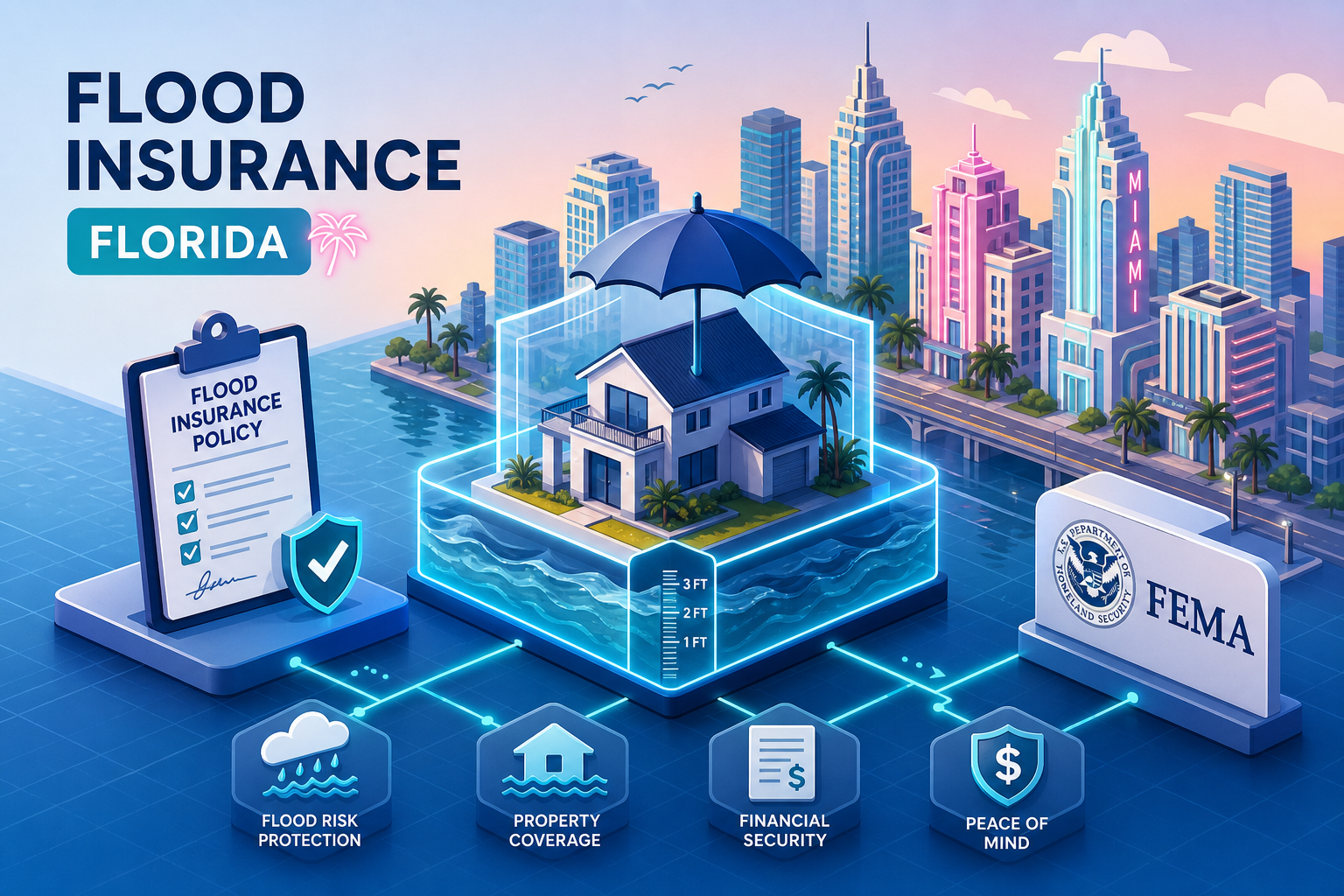
Flood insurance in Florida is not optional for millions of homeowners, it’s a financial necessity that most standard policies completely ignore. Florida accounts for more insured flood losses than almost any other state in the country, yet millions of homes here carry zero flood coverage. That gap isn’t ignorance. It’s a widespread assumption that a standard homeowners policy handles flood damage. It doesn’t. Not one dollar of flood damage from rising water is covered under a standard HO-3 or HO-6 policy.
FEMA’s National Flood Insurance Program is the most common solution, and it works for many Florida homeowners. But NFIP comes with coverage caps, exclusions, and waiting periods that most property owners don’t discover until after a claim. At our Brickell office, flood zone questions are the single most common issue clients bring through the door: what zone am I in, what does the policy actually cover, and can I find a better rate elsewhere?
This article answers all of it, a complete breakdown of how NFIP works in Florida, what it costs, where the gaps are, and how private flood insurance fills those gaps.
What FEMA’s NFIP actually covers in Florida
An NFIP residential policy divides into two separate coverage buckets: building coverage and contents coverage. Building coverage protects the structure itself, including the foundation, electrical systems, HVAC, plumbing, and built-in appliances, up to a maximum of $250,000. Contents coverage protects your personal property, furniture, clothing, and electronics, up to $100,000. These two buckets are separate purchases. Buying building coverage does not automatically include contents protection.
Several exclusions catch Florida homeowners off guard. NFIP does not cover additional living expenses or temporary housing if a flood forces you out of your home. Contents are paid at actual cash value, meaning depreciation is applied rather than replacement cost. Coverage is also limited or excluded for belongings stored below the lowest elevated floor, which matters in elevated coastal homes with enclosures or storage underneath. High-value homes and owners with significant personal property collections frequently run into these limits.
The 30-day waiting period is one of the most consequential NFIP rules. In most cases, a new NFIP policy doesn’t take effect until 30 days after purchase. There are exceptions, loan closings and lender-required coverage triggered by a map revision, but those exceptions are narrow. Buying a policy after a named storm enters the Gulf of Mexico does nothing for that storm.
How Florida flood zones and FEMA maps affect your premium
FEMA’s flood maps assign every property a zone designation, and that designation does two things: it sets the risk classification used to price your policy, and it can trigger a mandatory insurance requirement from your mortgage lender. Understanding your zone is the first step before getting any flood insurance quote in Florida.
Zone X, AE, and VE: What the designations mean
Zone X covers areas with minimal to moderate flood risk. Zone AE is the workhorse designation for high-risk areas, it establishes a base flood elevation (BFE), the calculated water level in a major flood event, and it’s the zone where elevation certificates have the most direct impact on your premium. Zone VE is the most hazardous category, covering coastal areas exposed to wave action on top of flooding, and it carries the highest NFIP rates as a result. All A and V zones are classified as Special Flood Hazard Areas (SFHAs). If your home carries a federally backed mortgage and sits in an SFHA, your lender requires flood insurance, no exceptions.
Why an elevation certificate matters before you quote
An elevation certificate is one of the most useful tools a Florida homeowner can get before buying flood insurance. This document, completed by a licensed land surveyor or engineer, records exactly how your home’s finished floor sits relative to the BFE. A home that sits two feet above BFE in Zone AE can qualify for significantly lower NFIP rates than an identical home at or below BFE. Elevation certificates are also required for certain local floodplain compliance purposes and help owners understand their mitigation options. Before quoting in Zone AE, the upfront surveying cost is almost always worth it.
What flood insurance actually costs in Florida
Premium ranges vary far more than most homeowners expect, and the difference between two neighbors can run into thousands of dollars per year. Zone X policies typically run $350 to $650 annually. Zone AE policies fall between $1,200 and $6,000 depending on how the home’s elevation compares to BFE. Zone VE policies can run from $4,000 to over $12,000 annually, reflecting wave-action exposure stacked on top of standard flood risk.
County-level data illustrates just how wide the spread is across South Florida. Miami-Dade averages around $670 per year. Broward comes in around $943. Monroe County, covering the Florida Keys, averages over $4,600 annually under FEMA’s current risk-based pricing. Interior counties like Orange and Polk cluster in the $600 to $650 range. For a detailed local breakdown, see our article How Much Does Flood Insurance Cost in Miami in 2026?
How Risk Rating 2.0 changed the math
These averages reflect FEMA’s Risk Rating 2.0 methodology, which moved NFIP away from zone-label pricing and toward property-specific risk factors: elevation, distance to water, foundation type, flood type, and replacement cost. Two homes on the same street can now carry very different premiums.
About 20% of Florida policyholders saw an immediate decrease under Risk Rating 2.0, while the majority saw modest increases. Many policies are still working through a phased glide path toward full actuarial pricing, with annual increases capped at 18% under federal law, which means some 2026 premiums are still below the true risk price. For consumer-oriented coverage and cost comparisons tied to the newer pricing model, see Bankrate’s practical guide to flood insurance in Florida for context.
Where NFIP falls short and private flood fills the gap
Private flood insurance in Florida has expanded significantly, and for many homeowners it deserves a side-by-side comparison with NFIP rather than a secondary look. The coverage differences are meaningful. Private policies commonly offer higher building limits, some carriers go to $5 million, $7.5 million, or higher. Contents can be covered at replacement cost rather than actual cash value. Many private policies include loss-of-use coverage, the additional living expenses NFIP explicitly excludes. Waiting periods are shorter too, typically 7 to 15 days versus NFIP’s 30.
Is private flood cheaper than NFIP?
Private flood is not automatically more expensive. According to analysis cited by the Insurance Information Institute, roughly 77% of Florida homes may qualify for lower premiums through private flood than through NFIP. Carriers like Palomar average around $431 per year in some comparisons, and Kin offers Zone X coverage starting around $175 per year, both well below the statewide NFIP average. Higher-limit private policies from carriers like Chubb, aimed at homes needing $15 million in combined coverage, will cost more, but they serve a different buyer entirely.
The homeowners with the strongest reason to run private quotes alongside NFIP are those with high-value homes, waterfront properties, and anyone who needs coverage above the $250,000 NFIP building cap. Excess flood coverage is also available as a separate layer for owners who want NFIP as a base policy but need additional protection above its limits. An independent agent can structure both layers together. For an industry roundup of private options and carriers, consult a list of the best flood insurance companies that specialize in flood products.
The Citizens Property Insurance flood rule you can’t ignore
Florida created a Citizens-specific flood insurance requirement that now affects hundreds of thousands of policyholders. If you have a Citizens personal residential policy that includes wind coverage, flood insurance is required under a phase-in schedule based on your home’s dwelling value. Homes valued at $600,000 or more were required to comply starting in 2024. The $400,000-and-above threshold applies to policies renewing in 2026. By January 1, 2027, all remaining Citizens personal residential policies with wind coverage must carry flood insurance.
The flood policy must provide dwelling coverage at least equal to your Citizens Coverage A limit, or the maximum NFIP limit if the cap applies. A 2024 statutory amendment clarified one important point: if you’re buying flood insurance specifically to satisfy the Citizens requirement, contents coverage is not required, only dwelling coverage counts toward compliance. Condominium unit-owner policies, tenant-content policies, and Citizens policies that exclude wind coverage are currently exempt from this rule. See the official Citizens guidance on flood coverage rules for details and timing.
The practical takeaway: check your Citizens renewal date and confirm your flood policy is in place before your required compliance year arrives. Losing Citizens eligibility because flood coverage lapsed is an expensive problem to fix mid-policy year.
How to compare flood insurance options for your Miami property
Most Florida homeowners should request both an NFIP quote and at least one private flood quote at the same time. Comparing only one option leaves real money and real coverage on the table. The variables worth reviewing side by side include dwelling and contents limits, loss-of-use coverage, waiting period, deductible, and annual premium. If your home is in Zone AE, get an elevation certificate before quoting, it can shift your NFIP rate significantly and affects private carrier pricing too.
This is exactly the process at We Insure Downtown Miami. As an independent agency in Brickell, the team works across multiple carriers, handles NFIP applications, reviews elevation certificates, and identifies whether a property triggers the Citizens flood mandate before a renewal catches a client off guard. Rather than submitting one application and accepting a single number, clients get a side-by-side comparison built around their specific flood zone, property type, and coverage goals.
That comparison matters whether you own a waterfront home in Coconut Grove, a condo in Brickell, or a small commercial property in Wynwood. Flood exposure and pricing are highly specific in Miami-Dade, and the right flood insurance policy for one property is rarely the right policy for the one next door. For more on navigating downtown risks and policy details, see our post Flood Insurance in Downtown Miami (What FEMA Won’t Tell You).
The bottom line on flood insurance in Florida
Flood insurance in Florida is not one-size-fits-all. NFIP provides a solid foundation for many property owners but comes with caps and exclusions that leave real gaps, especially for higher-value homes and anyone who needs living expense coverage after a flood. Private flood insurance addresses most of those gaps, and in many cases costs less than homeowners assume. Flood zones and elevation drive premiums more than most people realize, and an elevation certificate is often the single most cost-effective first step for Zone AE properties.
The Citizens mandate means more Florida homeowners than ever face a real compliance deadline. The worst time to figure out flood coverage is the week before a named storm or the week before a Citizens renewal lapses. Both scenarios are avoidable with a single conversation.
Connect with We Insure Downtown Miami to compare flood insurance Florida options and confirm the right coverage level for your property. You can get quotes online, by phone, or in person at our Brickell office. The comparison takes less time than most people expect, and the difference in coverage and cost is almost always worth it.
Leave a Reply