

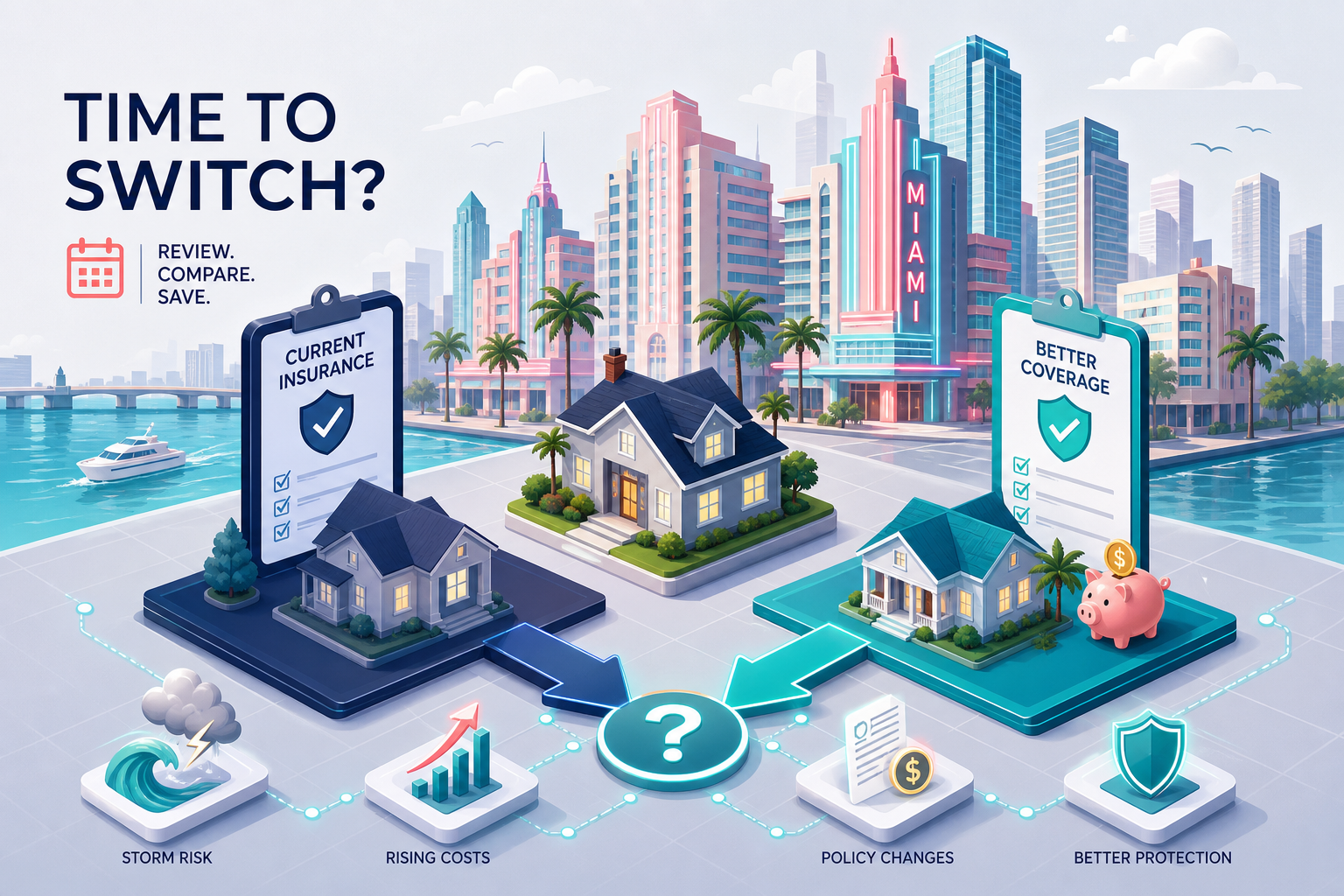
Florida’s home insurance market has been in near-constant flux. Carriers have pulled out, premiums have spiked, and underwriting rules have tightened on coastal properties across Miami-Dade and beyond. The good news is that deciding to switch your home insurance provider in Florida is completely legal, often straightforward, and can sometimes save you hundreds of dollars a year if you do it in the right order. At We Insure Downtown Miami, mid-term policy reviews are among the most common requests we handle from homeowners who’ve realized they’re overpaying, underinsured, or stuck with a carrier heading toward the exit. This guide walks you through exactly when to make the move, what to compare, how to time the transition, and how to handle the paperwork so you’re never uninsured for a single day.
Clear signs it’s time to switch your home insurance provider in Florida
The most common trigger is a significant rate increase at renewal with no major claim attached to it. Florida carriers adjust rates annually based on statewide loss experience, reinsurance costs, and hurricane modeling. If your premium climbed more than 15 to 20 percent, a threshold many insurance advisors use as a practical rule of thumb, and your property hasn’t changed, that’s a reasonable signal to start comparing replacement options today, not at the next renewal cycle.
Non-renewal notices are the other major trigger. Since 2022, several Florida insurers have either become insolvent or announced market exits. When you receive a non-renewal notice, check the notice itself and the Florida Office of Insurance Regulation guidance for the exact timeframe that applies to your situation, since required notice periods can vary by circumstance. Some high-risk coastal properties also take longer to place with a private carrier. Start comparing the day that notice arrives, not the week before your coverage lapses.
A third reason to reassess is a dwelling limit that hasn’t kept pace with South Florida’s construction costs. If your policy hasn’t been revisited in several years, the coverage limit may pay out far less than it costs to actually rebuild after a hurricane, a gap that remains invisible until you file a claim, which is exactly the worst time to discover it. Professional replacement-cost appraisals or insurer-approved valuation tools can help you establish an accurate current figure.
What to compare when evaluating replacement policies
Florida homeowners insurance quotes are not apples-to-apples comparisons. Pay close attention to your dwelling limit (Coverage A), your all-other-perils deductible, and your separate hurricane or named-storm deductible. Florida hurricane deductibles are percentage-based, typically 2%, 5%, or 10% of your dwelling limit, with a $500 fixed option available in some cases for lower-value homes, so it’s worth checking OIR guidance for the full range of options that apply to your property. On a $400,000 home, a 5% deductible means you’re paying $20,000 out of pocket before coverage kicks in for storm damage. That number deserves serious attention when you’re comparing quotes side by side.
Wind mitigation credits are one of the biggest variables in Florida premium calculations, and they’re often overlooked during a switch. If your home has impact-resistant windows, a hip roof, reinforced roof decking, or secondary water resistance, you may qualify for credits that can substantially reduce the wind portion of your premium, savings that can be significant depending on your property’s specific features and the carrier’s rating methodology (Florida Statute §627.0629 governs these credits). When requesting quotes from new carriers, submit your wind mitigation inspection report upfront. Carriers factor these features differently in their rate calculations, which is why identical homes on the same block can carry very different premiums. For an overview of how wind mitigation credits affect Florida premiums, see Progressive’s guide to Florida wind mitigation discounts.
Before you bind any new policy, verify that the carrier holds a valid certificate of authority from the Florida Office of Insurance Regulation. Not every insurer advertising online is approved to write policies in Florida. Check the OIR’s carrier search tool and review the company’s AM Best rating. A B-rated or unrated carrier is a real risk in a state that stress-tests insurers every hurricane season.
How to time your switch and avoid a coverage gap
The single most important rule when you switch home insurance providers in Florida: your new policy must be active before your old one ends. New homeowners policies in Florida typically become effective the day after binding and receiving the first premium payment. There is no mandatory statewide waiting period for property coverage, so same-day or next-day effective dates are often available. Schedule your new policy to start one day before you cancel the old one as a simple, reliable safety buffer.
Many homeowners assume they have to wait until renewal to change carriers. You don’t. Policyholders in Florida can generally request cancellation at any time with written notice, and your insurer is typically required to refund any unearned premium within 15 business days. If you’re ten months into a policy and a significantly better rate is available, switching mid-term still makes financial sense in most cases. Run the math on the pro-rated refund against the new premium before deciding. For practical guidance on the process of changing homeowners insurance and timing, see this Bankrate overview on changing homeowners insurance.
Florida law also requires most insurers to provide a 30-day grace period on premium payments after the first payment, during which coverage stays in force. This protects you if there’s a brief lag in payment processing during the switch. It is not, however, a substitute for proper timing. The grace period covers accidental payment delays, not intentional lapses. Plan your effective dates deliberately and don’t rely on the grace period as your safety net.
How to cancel your old policy and notify your lender correctly
Florida law requires any policyholder-initiated cancellation to be submitted in writing. Your request should include your full name as the named insured, your policy number, the property address, your requested cancellation date, and your contact information. Send it via certified mail or email with delivery confirmation. Oral cancellations are unreliable and can cause billing disputes that drag on for weeks, costing you time and potentially continuing premium charges you’ll need to dispute and recover. For common issues around cancellation after a claim, including how carriers handle such situations, this article is helpful: Can an insurance company cancel your homeowners policy after a claim?
If you have a mortgage, your lender is listed on your policy as an additional interested party through the mortgagee clause. When you switch carriers, update that clause with your new insurer and send your new declarations page to your mortgage servicer promptly, most servicers and mortgage contracts expect this within roughly 5 to 10 days of the policy change, though this is a servicer or loan-contract requirement rather than a Florida statutory deadline. Log into your servicer’s portal or email their insurance department directly with your loan number, property address, and the new declarations page attached. Skipping this step can trigger force-placed insurance, which is typically far more expensive than comparable coverage available on the open market.
Once your old carrier processes the cancellation, they owe you a pro-rated refund on the unused portion of your premium within three business weeks. If your premium is escrowed, the refund typically goes back to your lender’s escrow account, which will adjust your monthly payment accordingly. Follow up if you haven’t received confirmation within three weeks. For statutory details about cancellation and notice requirements, you can review the relevant Florida statute: Florida Statute 627.4133.
Florida underwriting factors that shape eligibility and your new premium
Roof age is one of the top reasons Florida homeowners get declined or quoted at elevated rates when they try to switch home insurance providers. Many insurers decline coverage on roofs older than 15 to 20 years, or offer actual cash value rather than replacement cost coverage for aging roofs, which can leave you significantly undercompensated after a storm. If your roof is approaching that threshold, get an inspection beforehand and document its current condition. Some carriers will accept an inspection report confirming the roof still has usable life remaining, which can make the difference between being accepted or rejected.
Carriers also pull your Comprehensive Loss Underwriting Exchange (CLUE) report when you apply for coverage. This report shows your claims history for the past seven years across all prior insurers. Multiple claims, even relatively small ones, raise red flags during underwriting. As a general matter of typical underwriting practice, two or more claims in the past three years won’t necessarily disqualify you, but they will narrow the field of willing carriers and push premiums higher. Knowing your CLUE report before you start shopping lets you anticipate those conversations rather than being surprised by them. For guidance on assessing whether your coverage is keeping up with current risks, see our piece Is Your Homeowners Insurance Built to Last?, Ruya.
Homeowners within high-risk coastal zones, particularly within 1,500 feet of water, often face limited private market options for windstorm coverage. In these areas, private policies frequently exclude wind entirely, requiring a separate Citizens Property Insurance wind-only policy layered on top of your all-perils coverage. If you’re evaluating a carrier switch on a coastal property, confirm upfront whether wind is included in the new policy or whether you’ll be managing a two-policy structure. That structure isn’t a deal-breaker, but it changes the total cost comparison significantly.
The fastest way to switch home insurance provider in Florida and secure replacement coverage in Miami
Shopping directly with each carrier means submitting your property details repeatedly, waiting on separate quotes, and comparing documents that use different formats and terminology. An independent agent accesses multiple carriers simultaneously and can run a side-by-side comparison in a single session. For Florida homeowners, this matters especially because carrier availability varies by zip code, distance from the coast, roof type, and claims history. Some carriers are ruled out before you’ve even spent time requesting a quote, and an independent agent identifies those disqualifiers upfront rather than after the fact.
A mid-term policy review covers more than just the premium line. It’s a structured look at whether your current coverage limits still reflect your home’s actual rebuild value, whether your deductibles create a manageable financial exposure, whether your carrier remains financially stable, and whether new carriers in the Florida market now offer more competitive options for your specific property profile. Homeowners in Miami-Dade who complete a mid-term review with an independent agency may find both coverage improvements and premium savings they wouldn’t have discovered by waiting for renewal. For specific recommendations tailored to local buyers, see our Best Insurance Options for Miami Homeowners in 2026, Ruya.
If your last policy review was more than 18 months ago, it’s worth considering a fresh comparison. Florida’s insurance market in 2026 looks considerably different than it did even two years ago, with new carriers authorized by the OIR and ongoing depopulation efforts pulling policies out of Citizens into the private market. That movement creates legitimate opportunities for homeowners who take the time to look. For broader context on the state of the market, see Florida Homeowners Insurance Crisis 2026: What Homeowners Need to Know, Ruya.
The right move, done in the right order
Knowing when and how to switch home insurance providers in Florida is one of the most practical steps you can take as a homeowner, especially in a market that moves as fast as this one. The sequence matters: secure your new policy first, confirm the effective dates overlap, then cancel your old policy and notify your lender. Pay attention to what’s actually inside the policy, not just the premium. Wind deductibles, roof conditions, and carrier authorization all matter the moment you file a claim, and that moment comes without warning in South Florida.
If you want to compare your current policy against the top carriers writing in Florida right now, the team at We Insure Downtown Miami handles exactly this kind of review. We work across multiple carriers and know the Florida-specific variables that affect your quote. There’s no obligation to move forward. There’s no reason to stay in a policy that no longer fits your home, your risk profile, or your budget.
Leave a Reply