

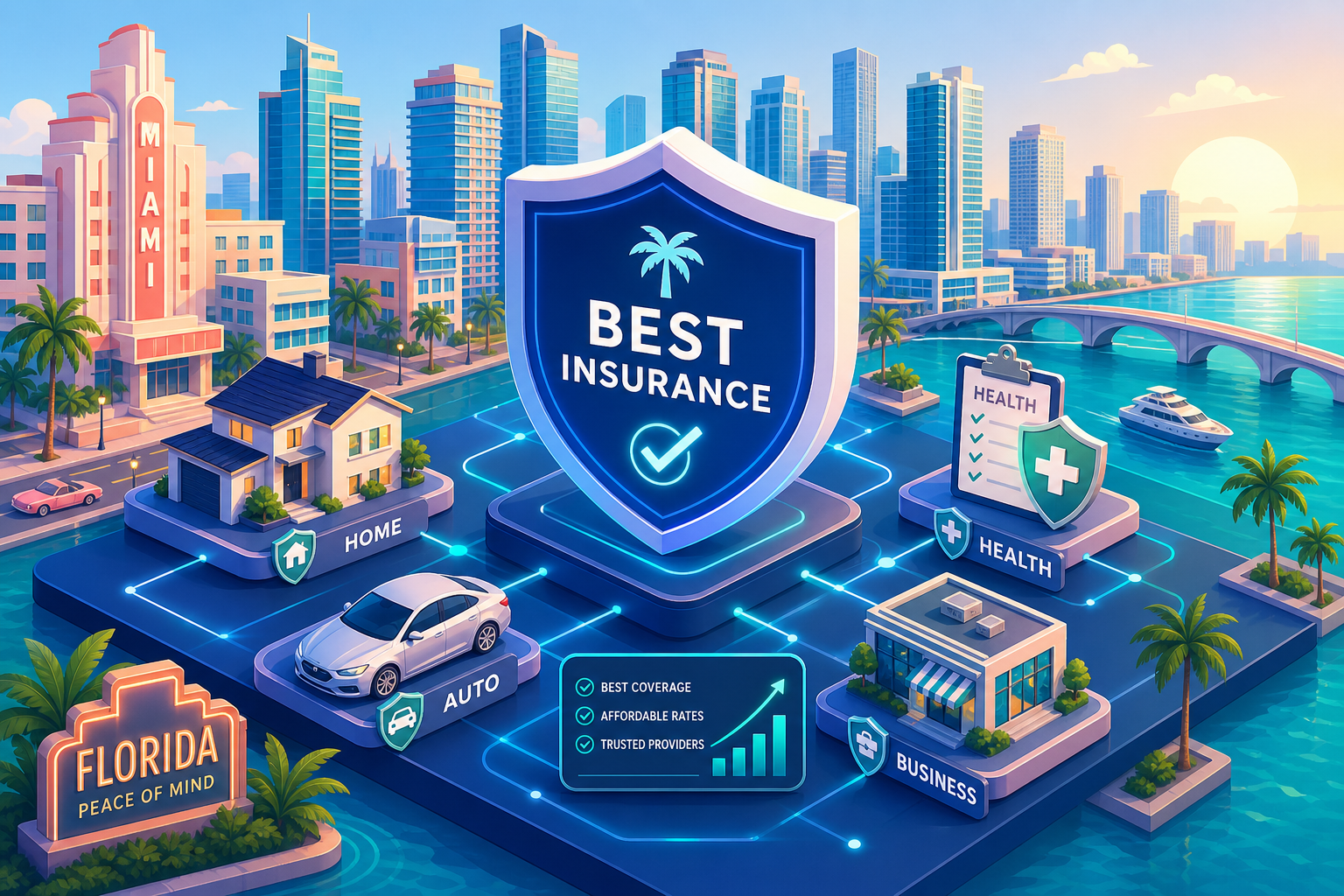
Florida runs on different rules than the rest of the country. If you’re shopping for insurance in Florida, you’re entering one of the most complex and expensive markets in the nation, and the reasons go deeper than most residents realize. Hurricane exposure, active flood zones, a historically litigious claims environment, and a no-fault auto system all push premiums well above the national average. Miami-Dade homeowners now pay upward of $5,000 per year on average, against a national average closer to $1,192. Miami drivers average $3,287 per year for full auto coverage, the highest of any major Florida city.
At We Insure Downtown Miami, these are the exact questions our Brickell-based team fields every day. Residents from Doral to Downtown Miami consistently misread their policies, carry the wrong coverage, or leave significant discounts on the table. This guide covers what you actually need for Florida insurance, what state law requires, and how to compare the market effectively so you get the best available rate without sacrificing the protection that Florida’s risks demand.
Why Florida insurance works differently than the rest of the country
Florida’s insurance challenges aren’t just about cost. They’re about availability, carrier appetite for specific risks, and legislation that has shaped, and sometimes shaken, the market for decades. Understanding the foundation makes every coverage decision easier.
The hurricane factor and its effect on every policy
Every policy in Florida, from a single-family homeowners policy in Kendall to a commercial property package in Wynwood, gets priced with catastrophic storm loss in mind. Two identical homes in Miami and Columbus, Ohio, carry dramatically different premiums because the underwriting math is completely different. Carriers weigh historical storm tracks, proximity to the coast, roof age, and construction type before setting a rate. When private insurers exit certain markets entirely, Citizens Property Insurance steps in as Florida’s insurer of last resort, providing coverage when the private market won’t, but with its own limitations and mandatory participation requirements.
How 2026 legislative reforms are reshaping rates
The market is stabilizing after years of volatility driven by litigation abuse and claim manipulation. Tort reform has had a measurable effect: insurers like Florida Peninsula have filed rate reductions of 8.2%, and Security First has dropped rates by 8%. Miami-Dade County is seeing some of the largest reductions in the state, projected at 14.0% for eligible policies. The market is still far from cheap, but the trajectory is improving. Shopping your coverage annually matters more in Florida than in almost any other state, precisely because these shifts happen faster here.
What Florida auto insurance laws require from every driver
Florida operates under a no-fault auto insurance system, which means your own insurance covers your medical expenses after an accident regardless of who caused it. Understanding the current minimums, and the gaps they leave open, is essential before you renew or purchase a new policy.
The PIP/PDL system and what it actually covers
Florida currently requires $10,000 in Personal Injury Protection (PIP) and $10,000 in Property Damage Liability (PDL) to legally register and drive a vehicle in the state. PIP covers 80% of your medical expenses and 60% of lost wages after an accident regardless of fault, but requires you to seek treatment within 14 days of the incident. PDL covers damage you cause to someone else’s property. Understanding these minimum car insurance requirements helps you see the gaps PIP leaves open.
Bodily Injury Liability is not currently mandatory for most Florida drivers, which creates real financial exposure if you cause an accident and the injured party’s damages exceed your coverage. A reform bill that would have replaced PIP with a $25,000/$50,000 Bodily Injury Liability minimum died in committee in 2025, so the current minimums remain in effect. Carrying voluntary bodily injury coverage is one of the most important additions any Florida driver can make to a policy.
Why Miami drivers pay the highest auto rates in the state
Miami averages $3,287 per year for full auto coverage, compared to $2,569 in Jacksonville and $1,721 for minimum-only coverage statewide. Dense traffic, high accident frequency, elevated repair and medical costs, and ZIP-code-level claim history all factor into that number. Based on our quoting experience, some Miami-area ZIP codes push full-coverage averages well above $5,000 annually. Working with an independent agency that compares Florida insurance quotes across multiple carriers simultaneously is the most reliable way to find competitive pricing within this high-cost environment. See more on the average cost of car insurance in Florida.
Hurricane coverage: what your homeowners policy actually covers
This is where most Florida homeowners discover a painful gap, usually after a storm has already passed. Standard homeowners insurance covers direct wind damage from a hurricane. It does not cover flooding from storm surge or rainfall accumulation, which are separate events requiring separate policies entirely. For a deeper look at common homeowners coverage gaps, see Is Your Homeowners Insurance Built to Last?
Named storm deductibles and how they trigger
Florida law requires insurers to offer hurricane deductibles of 2%, 5%, or 10% of your dwelling’s Coverage A limit. Homes insured for $250,000 or more have no access to a flat $500 deductible option. These deductibles only activate when the National Hurricane Center officially names a storm, which means a 2% deductible on a $400,000 home translates to $8,000 out of pocket before your carrier pays anything. Wind mitigation features reduce this impact directly. Verified hurricane shutters, reinforced roof connections, hip roof geometry, and secondary water resistance barriers can produce premium discounts for hurricane loss mitigation of 10, 30% or more on the windstorm portion of your policy. The My Safe Florida Home program also offers free inspections and grants up to $10,000 for qualifying upgrades.
What your policy won’t touch: storm surge and ground flooding
No standard homeowners policy covers flood damage of any kind, and Citizens policies don’t either. Storm surge caused the majority of catastrophic losses in recent Florida hurricanes, and it requires a completely separate flood policy to address. Assuming your homeowners coverage extends to flood is the single most expensive misunderstanding in Florida property insurance, and it’s one we see corrected only after it’s too late.
The flood gap most Florida residents don’t know they have
Flood insurance is consistently underpurchased across Florida, especially outside federally designated Special Flood Hazard Areas. Many homeowners outside these zones assume they don’t need it. South Florida’s drainage limitations and storm surge exposure make that assumption genuinely dangerous.
NFIP vs. private flood insurance: a practical comparison
The National Flood Insurance Program caps building coverage at $250,000 and contents at $100,000, with a 30-day waiting period for new policies and an average annual cost around $865. For a property with a replacement cost above $250,000, the NFIP cap creates a coverage gap before you even factor in contents, and most South Florida homes exceed that threshold by a significant margin.
Private flood insurance fills this space. Private carriers offer dwelling limits up to $10 million or more, replacement cost coverage for contents, and additional living expense coverage that NFIP doesn’t include at all. Waiting periods are typically shorter, ranging from 10 to 15 days. Lenders require flood coverage for properties in Special Flood Hazard Areas, and Citizens wind policies with dwelling limits over $500,000 trigger their own mandatory flood coverage requirements. If your home’s replacement cost exceeds NFIP’s building cap, private flood coverage isn’t a luxury, it’s a necessity.
Why condo owners in coastal high-rises face a different flood risk
Storm surge can affect lower floors of Brickell towers in ways that neither the building’s master policy nor a standard HO-6 addresses. NFIP limits are rarely sufficient for high-value units, and private flood policies with higher limits are often the only solution that genuinely closes this gap for Downtown Miami condo owners. If you live in a high-rise and haven’t reviewed your flood exposure specifically, that review is worth scheduling before the next storm season.
How condo owners handle what the association policy doesn’t cover
Florida condo association master policies cover the building structure and common areas, but coverage for unit interiors varies dramatically depending on how the master policy is written. Getting this wrong is one of the most common, and most costly, coverage mistakes we see in Brickell and Downtown Miami.
What the master policy actually covers (and where it stops)
“Bare walls in” master policies leave everything inside your unit, drywall, flooring, built-in cabinetry, and fixtures, entirely on you. Even “all-in” master policies often exclude betterments and improvements you’ve made since purchase. An HO-6 policy fills this space by covering interior structure, personal property, unit-specific liability, and loss of use. Confirming exactly what your association’s master policy covers before assuming you’re protected is not an optional step.
Loss assessment coverage and why condo owners shouldn’t skip it
When a major storm damages the building and the master policy’s coverage falls short, the gap gets divided among unit owners as a loss assessment. Loss assessment coverage within your HO-6 policy absorbs these unexpected bills before they become your personal financial problem. For condo owners in hurricane-prone high-rises, this endorsement is one of the most cost-effective protections available, and one of the most consistently skipped.
How to compare insurance in Florida and actually get the best rate
Knowing what you need is half the challenge. Finding the best rate for that coverage requires access to the full market, not just a single carrier’s quote page. In a state as complex as Florida, that distinction matters more than most people realize.
Why going directly to one carrier limits your options
A single-carrier quote gives you one data point. Florida’s active insurance market includes dozens of carriers with different underwriting appetites, rating algorithms, and discount structures. Progressive may price your auto aggressively; a specialty carrier may write your coastal homeowners policy more competitively. You won’t know the difference until you compare across the full market. Going carrier by carrier on your own takes hours and still doesn’t guarantee you’re seeing every option available to you.
How We Insure Downtown Miami does the comparison work for you
We Insure Downtown Miami is an independent agency in Brickell with access to multiple carriers simultaneously across auto, homeowners, condo, flood, commercial, umbrella, and life insurance. The team runs Florida insurance quotes across the full market, identifies applicable discounts, bundling can save up to 16% on auto, and verified wind mitigation features reduce homeowners premiums significantly, and matches coverage to each client’s actual risk profile rather than a generic policy template. Discover Our Blog for additional insights and local updates.
Quotes are available online, by phone, or in person at the Brickell office. There’s no commitment required to compare, and in a high-cost market like South Florida, the difference between one carrier’s rate and the best available rate is frequently substantial.
Getting Florida insurance right from the start
Florida’s insurance requirements are more complex than most states, and the stakes are proportionally higher. The cost of getting it wrong isn’t just a slightly elevated premium. It can mean a flood claim denied because you assumed your homeowners policy covered storm surge. It can mean a loss assessment bill arriving weeks after a hurricane. It can mean medical costs left partially uncompensated because your auto coverage stopped at PIP minimums. Each of these is a real scenario, and each is preventable.
The path to better coverage starts with understanding what your specific property, ZIP code, and risk profile actually require, then comparing the full market to find the best available value within that framework. We Insure Downtown Miami was built specifically for this environment: Florida-focused expertise, carrier access across every major coverage line, and a team that closes the gaps that generic policies consistently leave open.
Reach the Brickell office by phone, request a free Florida insurance quote online, or schedule an in-person meeting to get a full comparison across the market. Your current policy may be covering less than you think, and the only way to know for certain is to check.
Leave a Reply