

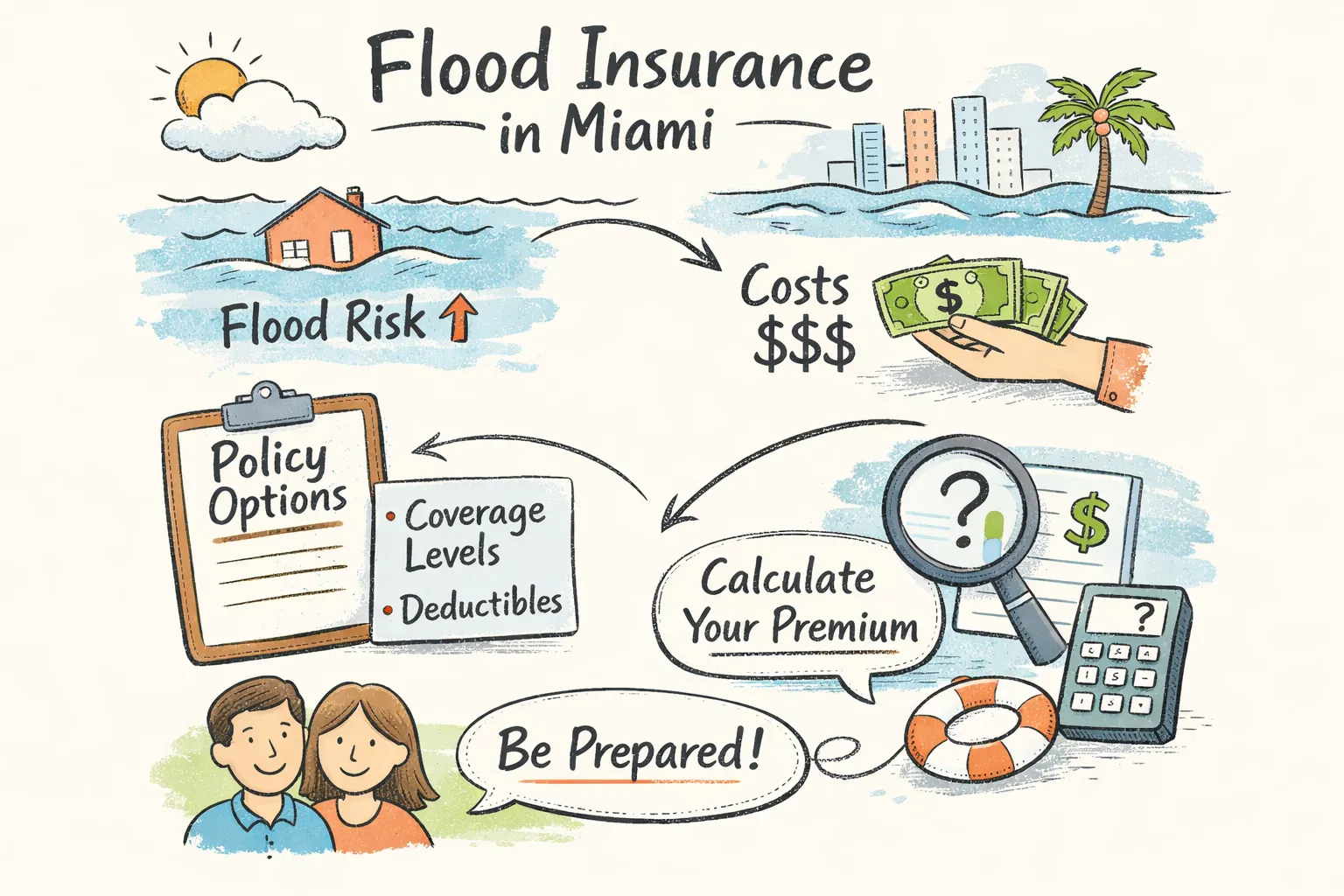
Flood insurance cost in Miami is typically higher than national averages. Sites like Bankrate and LendingTree publish state-level numbers, but those figures do not predict what your house on Biscayne Bay will pay. Coastal exposure, storm surge maps, and a high concentration of special flood hazard areas push Miami pricing higher, so local factors matter more than state or national averages.
What you need to know
Here are five key points to keep in mind when planning for flood insurance cost. Each item below affects price, availability, or both.
Expect higher rates. Miami premiums commonly exceed national averages because of coastal exposure and concentration of high-risk flood zones.
Primary cost drivers. Flood zone, elevation relative to the base flood elevation (BFE), and replacement cost are the main determinants of premium.
NFIP vs private. The NFIP offers standardized limits and rules while private insurers may offer alternative limits and pricing—compare both markets.
Reduce your premium. Mitigation measures (elevation, flood vents, relocating utilities) and proper documentation can lower costs.
Get a tailored quote. Share the property address, elevation or FEMA data, foundation type, and desired limits with your agent to get accurate pricing.
1. Quick forecast: what Miami homeowners should expect to pay
Use the NFIP national average of $926 per year and state surveys from Bankrate and LendingTree for context, keeping in mind their methods differ. Those anchors help set expectations but do not capture Miami’s coastal exposures and parcel-level differences.
For Miami properties, practical annual ranges are roughly: Zone X/B/C about $150–$700; AE zones $700–$1,800; and high-risk V zones or waterfront homes frequently $1,500–$3,500 or more. Private flood insurance can be 15–50 percent lower for similar limits in some cases, but eligibility and carrier pricing depend on elevation, construction, and underwriting appetite. Treat these ranges as starting points; a property-specific quote is the only way to know your actual premium.
Micro-location factors often trump ZIP-code averages: finished-floor height, foundation type, elevation relative to the BFE, and proximity to canals or the coast can cause wide rate differences between neighboring homes. Under Risk Rating 2.0, insurers price policies using parcel-level characteristics, so accurate elevation documents and replacement-cost figures matter more than before. Gather those records and compare NFIP and private offers to lock in an accurate premium.
2. How flood insurance cost is calculated in Miami
Flood insurance cost ultimately comes down to three core drivers: flood zone, elevation relative to the base flood elevation (BFE), and replacement cost. Zones such as VE and AE have higher base rates than X or B, while being lower above the BFE increases expected loss and therefore premium. Underwriters combine these inputs with local loss history to estimate your rate.
An elevation certificate documents your lowest floor height relative to the BFE and often produces measurable savings by proving lower exposure. Under Risk Rating 2.0, insurers price policies using individual property characteristics rather than coarse zone maps. Accurate documentation of elevation, building materials, and occupancy can directly reduce your flood insurance rates when you shop or update a policy.
Other important premium drivers include foundation type, prior flood claims, chosen deductible, and contents limits. Foundations on piles, crawlspaces, or slabs present different repair costs and underwriting outcomes, while higher deductibles lower premiums but increase out-of-pocket risk. Community and building-level mitigation such as CRS credits, elevating structures, installing flood vents, or an association master policy for condos can reduce individual premiums, and an independent agent can help identify applicable credits and document improvements to lower your cost.
3. NFIP vs private flood: pricing, coverage and tradeoffs
The National Flood Insurance Program sets baseline coverage and limits: building coverage up to $250,000 and contents coverage up to $100,000. New NFIP policies generally carry a 30-day waiting period before full coverage goes into effect, and lenders commonly accept NFIP wording as the default. Many buyers begin with NFIP while they explore private options.
Private carriers can offer higher limits, replacement-cost building coverage, and faster placement, sometimes binding a policy in days. Many homeowners see lower bills in the private market, with typical savings of 15–50 percent in comparable scenarios, but pricing and availability vary by carrier appetite, parcel risk, and policy terms. Private plans may include exclusions or capacity limits and can be unavailable in the highest-risk footprints.
Consider private when you need higher limits, replacement-cost building coverage, or faster placement, particularly for low-to-moderate risk properties near but not inside the riskiest zones. Keep NFIP when private capacity is thin, a lender requires NFIP wording, or your property sits in a catastrophic zone where private carriers withdraw. An independent agent will collect property facts, elevation and loss history, run NFIP calculations, and quote multiple private carriers so you can compare price, coverage, and exclusions side by side.
4. Real Miami scenarios: NFIP and private price examples
Scenario A: Brickell high-rise condo (HO-6 needs). A mid-floor Brickell unit with upgraded interior finishes and an association master policy that stops at the drywall can see NFIP-style costs for contents and limited building items around $1,000–$2,500 annually, depending on limits and deductible. Private markets typically consider stack level, replacement cost of interior improvements, and association gap risk, so a private policy plus an HO-6 endorsement might run roughly $700–$1,800 while providing broader coverage for interior improvements and loss assessment. Condo owners should confirm the association master policy language and buy an HO-6 to fill any gaps for unit improvements or assessments.
Scenario B: Biscayne Bay waterfront single-family home in an AE or V zone. High-risk waterfront homes commonly see NFIP estimates in the mid-thousands to low five figures annually when elevation and V-zone wave action are factors, for example $3,000–$8,000 depending on foundation elevation. Private carriers will quote a wide range, often $2,000–$10,000, and typically require an elevation certificate and stricter underwriting because surge and wave action increase both likelihood and severity of loss. Investing in an elevation certificate and mitigation such as piling or flood vents can materially reduce quotes from both NFIP and private markets.
Scenario C: Inland single-family home in Zone X or moderate risk. For homes outside special flood hazard areas, NFIP-style prices often fall around $400–$900 annually, while private market options sometimes offer comparable limits for $200–$600. About 25 percent of flood claims come from outside high-risk zones, so a Zone X designation does not guarantee immunity from flood damage. Private carriers tend to price these lower-risk inland homes competitively when elevation and replacement cost are favorable.
Use these scenarios to guide information gathering and prioritize documentation that underwriters value. Three quick, actionable steps save time and money.
- Identify your flood zone and verify whether you are in a V or AE area. Use FEMA maps or have an agent confirm your designation because zone differences affect rates.
- Obtain an elevation certificate or recent survey so underwriters can reward mitigation. If you do not have one, check with the county or association or order a new survey to document floor heights.
- Collect current replacement cost estimates and your association’s master policy language before you shop. Those documents determine building limits and reveal association gaps an HO-6 must fill.
Checking recent local quotes and state flood insurance premiums will help you set realistic expectations for flood insurance cost. Read on for proven mitigation steps and shopping tactics to lower your premium and compare final offers.
5. Proven ways to lower your flood insurance cost in Miami
Start with property improvements that directly reduce exposure and insurance bills. Practical steps include raising the lowest floor, installing flood vents, elevating HVAC and electrical systems, and sealing foundation openings. Vents and sealing are relatively quick and often pay back through premium credits, while elevating a structure is a larger investment that may take months to complete and should be weighed against long-term savings and resale value.
Use policy tactics and market shopping to reduce your premium further. Raise your deductible, compare building-only versus building-plus-contents options, and obtain quotes from multiple carriers including private insurers. Always review exclusions, loss assessment terms, and whether the policy pays replacement cost or actual cash value so you do not sacrifice critical coverage for short-term savings.
Do not overlook community credits and simple paperwork that unlock discounts. Check whether your municipality participates in the Community Rating System and provide an elevation certificate, recent property photos, and proof of mitigation work when you apply. An independent agent can match your property profile to carrier appetite and local underwriting nuances.
6. How to get an accurate flood insurance quote: checklist and next steps
Start by gathering core facts and documents so your agent can deliver an accurate, fast price. Having the right paperwork up front reduces back-and-forth and prevents surprises when comparing NFIP and private options.
Checklist: Bring these items to your appointment or upload them with your online request. Having them ready speeds placement and reduces follow-up questions.
- Full property address and unit number, which locates the exact flood zone and community rating. Include any cross-street or parcel ID if available.
- Year built and foundation type (slab, pilings, crawlspace), which affects vulnerability and premium calculations. Lenders and underwriters use this to estimate repair costs.
- Replacement cost estimate or recent appraisal, which sets dwelling limits for proper coverage. Replacement cost drives the building limit insurers quote, not market value alone.
- Mortgage or lender contact and loan number, since lenders often require proof of coverage or have placement timelines. Provide contact info so an agent can coordinate with the lender.
- Elevation certificate if available, because it can substantially lower your cost when the structure sits above base flood elevation. If you don’t have one, ask your county or association for existing records or consider ordering an updated survey.
- Prior flood claims history, as claims raise underwriting flags and influence available options. Provide dates and claim numbers where possible to speed review.
- Condo association master policy details (HOA), to coordinate unit-level HO-6 with the master policy to avoid gaps. Supply the sections that define building components and limits so an underwriter can calculate gap exposure.
Typical timeline from facts to a bound policy is short for standard profiles. Collecting documents and verifying elevation and loss history usually takes 1–3 business days, and insurers then calculate risk and issue pricing through NFIP or private underwriting over another 1–5 days depending on complexity.
Protect your home from flood insurance cost surprises
Your flood insurance cost depends on where your property sits, how high it sits relative to base flood elevation, and the type and amount of coverage you choose. Know your flood zone and compare NFIP and private options so you understand both price and protection and avoid sticker shock at renewal.
Small changes can move costs: elevation adjustments, mitigation credits, and choosing the right building versus contents limits affect both premium and out-of-pocket risk. Request a tailored, side-by-side flood quote from We Insure Downtown Miami by phone, online, or in person in Brickell to see the real numbers for your exact address and be ready before hurricane season. Our local office will walk you through required documents and mitigation credits to help you lock in the best available coverage.
Leave a Reply