

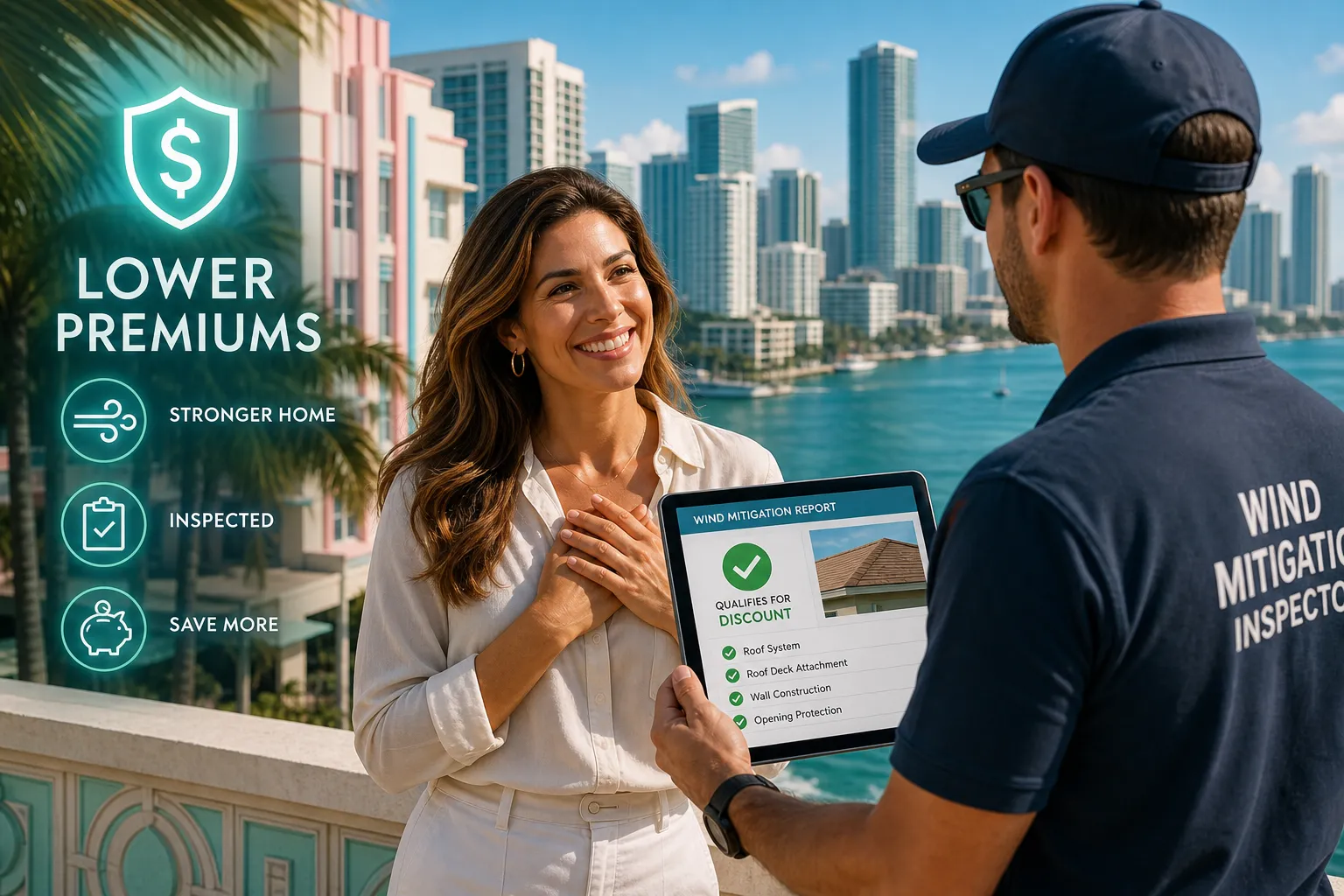
How does a wind mitigation inspection save money on home insurance in Florida? For coastal homeowners, it comes down to documented proof. Florida homeowners in coastal markets face some of the highest windstorm-related premiums in the country, yet many are unaware that a single inspection costing around $100 can unlock credits worth hundreds of dollars every year. A wind mitigation inspection gives your insurer documented proof that your home is built to withstand Florida’s storms. The discount isn’t theoretical, Florida law requires insurers to honor it once the paperwork lands on their desk.
The catch is that getting the inspection done is only half the job. Because every carrier applies those credits differently, the insurer you submit your report to matters as much as the report itself. At We Insure Downtown Miami, we work with Miami-Dade homeowners every day to shop a completed wind mitigation report across multiple top carriers and find where the actual savings land highest. That’s the difference between leaving money on the table and locking in the full benefit.
What happens during a wind mitigation inspection
A wind mitigation inspection is a structured visit from a licensed inspector who documents specific structural features of your home that reduce windstorm damage risk. The inspector is not looking for problems or deficiencies, this is purely about identifying which credit-qualifying features your home already has. The entire visit typically takes 30 to 60 minutes, and you walk away with a formal report you own and can submit to your insurer at any time.
The seven features your inspector documents
Every inspection follows the state’s official checklist, which covers seven specific items. Understanding what each one means helps you gauge your home’s credit potential before the inspector arrives.
- Roof geometry: Hip roofs with four sloping sides earn better credits than gable roofs. A hip roof alone can reduce the wind portion of your premium by roughly 20% in some cases, though actual discounts vary by carrier and county.
- Roof deck attachment: The inspector checks whether your decking is fastened with code-compliant nails rather than staples, and whether the nail size and spacing meet current standards.
- Roof-to-wall connection: The hardware grade matters here. Hurricane clips, single wraps, and double wraps each earn a different credit level, with double wraps earning the highest.
- Roof covering: The material type, its age, and whether it meets the Florida Building Code all factor into this rating.
- Secondary water resistance (SWR): A sealed peel-and-stick membrane installed under the roof covering can earn a 10%, 15% reduction on the wind portion of your premium by preventing water intrusion if shingles are lost in a storm.
- Opening protection: Impact-rated windows, doors, code-approved shutters, and reinforced garage doors are all evaluated here. This is often the largest single credit on the entire report.
- Building code and year built: Homes permitted under the 2002 Florida Building Code or later may qualify for meaningful windstorm discounts on top of other documented feature credits, with the exact percentage varying by carrier and territory.
Why opening protection follows an all-or-nothing rule
Opening protection is the most misunderstood feature in wind mitigation, and getting it wrong is expensive. If even one window, door, or opening in the home lacks qualifying protection, the entire opening protection credit disappears from your report. One unprotected skylight or a non-impact side window can wipe out what could be the largest single credit available to you.
Before your inspection, walk the full perimeter of your home and identify every opening. The inspector will do the same, and any gap they find eliminates the credit entirely for that category. Knowing this in advance gives you the chance to address gaps before the inspection rather than after.
The official report and how your wind mitigation inspection discount gets applied
Once the inspection wraps up, the findings are recorded on the state-mandated form and submitted to your insurer. Under Florida Statute 627.0629, insurers are required to apply corresponding credits upon receipt of a valid report, though carriers may still verify documentation or conduct audits before or after the credit is applied.
Inside the OIR-B1-1802 form
The official document Florida insurers must accept is the OIR-B1-1802 (Rev. 04/26), formally called the Uniform Mitigation Verification Inspection Form, updated effective April 1, 2026. Every insurer writing homeowners policies in Florida is legally required under Florida Statute 627.0629 to apply the corresponding credit once this OIR wind mitigation form is submitted. The completed form includes photographs documenting each of the seven features, along with supporting documentation such as permits, contractor invoices, or product approvals.
For impact windows and shutters to qualify for opening protection credit, the inspector must verify a valid Florida Product Approval number or a Miami-Dade Notice of Acceptance (NOA) number on each window, door, and shutter. Photos of the openings alone will not satisfy the requirement. Interior window film, decorative shutters, and standard blinds do not qualify under any circumstances, inspectors verify product approvals, not visual appearance.
Submitting the report and when savings kick in
The submission process is simple. Your inspector delivers the completed OIR-B1-1802 form with supporting photos, and you or your agent submits the package directly to your insurance carrier. The discount is applied at your next renewal or mid-term with a prorated premium adjustment, meaning you may see a partial credit before your renewal date if you submit during the policy year.
The report is valid for five years from the inspection date. A new inspection is required after that window, or sooner if you change roofing materials, install new windows, or make any structural modification to wind-resistant features. Keeping track of your report’s expiration date is simple but worth doing, an expired report means your credits stop applying.
Real savings numbers: how a wind mitigation inspection reduces Florida home insurance premiums
Abstract percentages are useful context, but real dollar numbers make the case concrete, here is what the math looks like on a typical Miami-area home.
A real-world savings example
Consider a homeowner in a coastal Miami zip code paying a $4,500 annual premium. The windstorm portion represents 50% of that bill, or $2,250. After submitting the OIR-B1-1802 form documenting a hip roof, double-wrap roof-to-wall connections, secondary water resistance, and full opening protection with impact windows, the carrier applies a combined 40% reduction on the windstorm portion. That equals $900 off the annual premium from a $100 inspection.
Homes permitted under the 2002 Florida Building Code with full opening protection can see reductions well above $1,000 annually, depending on the wind portion of the premium and the carrier’s filed discount schedule. Even a modest outcome, a 20% windstorm discount on a midrange policy, often delivers $300, $500 in annual savings, with the wind mitigation inspection cost recovering itself well within the first policy year.
Why the same report earns different discounts at different carriers
The OIR form is standardized statewide, but the actual percentage each carrier applies to each documented feature varies by their filed rates, your county, and your specific home profile. One carrier might give you a 25% reduction for secondary water resistance while another gives 15% for the exact same documented feature. The form is identical. The financial outcome is not.
This is where submitting your report through an independent agency like We Insure Downtown Miami creates real financial leverage. The same report gets shopped across multiple carriers simultaneously, so the windstorm insurance credit you actually receive is the best one available in the market, not just what your current insurer happens to offer based on their internal discount schedule.
What the inspection costs and how long it takes
For homeowners on the fence about scheduling, the numbers make the decision easy. A standalone wind mitigation inspection in Florida runs between $75 and $175, with most homeowners paying around $100. In South Florida and the Miami metro area, standard homes typically fall in the $95, $120 range, though larger or more complex properties can reach $150, $300. The inspection itself takes 30 to 60 minutes, and most inspectors deliver the completed OIR form and photos within one to two business days, with some offering same-day digital delivery.
Your inspector must hold one of the following Florida licenses: home inspector, building code inspector, contractor, professional engineer, or architect. Verify credentials before booking. An inspection completed by an unqualified inspector produces a report your carrier is not obligated to honor, which means the credit disappears entirely.
Bundling with a 4-point inspection to save money
Many Florida homeowners need both a wind mitigation inspection and a 4-point inspection, which covers the roof, electrical, plumbing, and HVAC systems. This is especially common when obtaining or renewing coverage on homes over 20 years old. Booking both inspections on the same visit typically runs $150, $250, saving roughly $75, $80 compared to scheduling them separately. If you are shopping for a new policy and your home is over two decades old, combining both inspections in one appointment is the practical move.
Which upgrades earn bigger credits and how fast they pay off
If your inspection reveals gaps, knowing which investments close them most efficiently saves you from overspending on upgrades that return modest credits while underspending on the ones that move the needle most. For broader context on which improvements most reliably increase property value, see improvements that increase home value.
Opening protection: the highest-value single upgrade
Installing impact-rated windows and doors or code-approved hurricane shutters is the most powerful single upgrade because opening protection carries the largest homeowners insurance wind discount on the OIR form. Florida homeowners who qualify for full opening protection credit typically see $300, $500 in annual savings on their windstorm premium, and in some cases significantly more depending on the carrier and their home’s overall profile.
For a Miami home, the installed cost of impact windows typically runs $12,000, $35,000 depending on the number of openings, window tier, and HVHZ requirements. Accordion hurricane shutters are a lower-cost alternative, with whole-home installations typically running $4,000, $12,000, and both qualify as long as they carry a valid Florida Product Approval number or Miami-Dade NOA. Based on typical annual premium reductions in the $300, $500 range, the payback period on shutters through premium savings alone is often two to four years, making them one of the more cost-efficient upgrades available to Miami homeowners.
Secondary water resistance and roof connection hardware
Secondary water resistance, the peel-and-stick membrane installed under your roof covering, can earn a 10%, 15% reduction on the windstorm portion of your premium. The most cost-effective time to add it is during a roof replacement, since the incremental cost of including SWR membrane during active construction is far lower than retrofitting it independently afterward.
Upgrading roof-to-wall connections from clips to double wraps adds another layer of credit that stacks with other documented features. Like SWR, this upgrade is most financially efficient when planned alongside a roof replacement, since the cost of improved strapping during construction is minimal compared to a standalone retrofit project. Both features are documented on the OIR-B1-1802 form and can meaningfully shift your premium the next time you submit an updated inspection report.
Frequently asked questions: how wind mitigation inspections save money on home insurance in Florida
How long does the wind mitigation report stay valid?
The completed OIR-B1-1802 report is valid for five years. It expires sooner if you replace roofing materials, install new windows, or make structural changes to any wind-resistant features.
Can I submit the same report to multiple carriers?
Yes. You own the report and can submit it to any licensed Florida insurer or ask an independent agency like We Insure Downtown Miami to shop it across multiple carriers at once to find where the hurricane mitigation credits land highest.
Does every home qualify for savings?
Most homes qualify for at least some credits. The size of the discount depends on which of the seven features your home already has and which carrier receives the report. Older homes built before 2002 often still qualify for meaningful roof-to-wall connection and opening protection credits.
Lock in the full benefit, not just the inspection
A wind mitigation inspection is a low-cost, one-time investment that produces documented proof your home is more storm-resistant than average, and Florida law requires insurers to reward that proof with real premium credits. The core steps are clear: hire a licensed inspector, document all seven features with photos, use the updated OIR-B1-1802 (Rev. 04/26) form, and submit to your insurer promptly. The report does the heavy lifting once it’s in your carrier’s hands.
The variable in the equation is which carrier receives that report. Because every insurer applies OIR credits according to their own filed discount schedule, the same completed form can produce meaningfully different savings depending on where it lands. We Insure Downtown Miami works with homeowners across Miami-Dade and South Florida to shop a completed inspection report across top carriers, compare the actual windstorm insurance credit each one applies to your specific home profile, and place the policy where the savings are greatest.
Contact We Insure Downtown Miami today to run a carrier comparison using your existing wind mitigation report or to get guidance before you schedule your inspection. One conversation can show you exactly how much you are leaving on the table with your current insurer, and how a wind mitigation inspection saves money on your Florida home insurance from the very first renewal.
Leave a Reply